Thursday, 6 June 2024

Application of the rule according to Ryland vs Fletcher in Kenya

by: Agak R. R. Scott 

Introduction

The Rylands v Fletcher rule, established by the English courts in 1868, is a cornerstone of tort law, particularly in matters concerning strict liability. This rule posits that a person who brings something onto their property that is likely to cause harm if it escapes is responsible for any resultant damage, irrespective of negligence. This doctrine has found its way into Kenyan jurisprudence, shaping the landscape of liability in various contexts.

Notable Applications in Kenya

One of the most significant cases demonstrating the application of the Rylands v Fletcher rule in Kenya is Kenya Power and Lighting Company Limited v Patel [2009] eKLR. In this case, the plaintiff’s property was destroyed by a fire emanating from an electric transformer owned and maintained by the defendant, Kenya Power and Lighting Company Limited. The plaintiff sought compensation under the principle of strict liability as enshrined in Rylands v Fletcher.

Judicial Reasoning and Decision

The court in this case reaffirmed the applicability of the Rylands v Fletcher rule, holding the defendant strictly liable for the damage caused by the transformer. The court’s reasoning was grounded in the principle that the transformer, being a potentially hazardous entity, posed a significant risk if it were to escape or malfunction. The fact that the transformer did indeed cause harm by initiating a fire was sufficient to invoke strict liability under the Rylands v Fletcher doctrine.

The court emphasized that the plaintiff was not required to demonstrate negligence on the part of the defendant. This aligns with the essence of the Rylands v Fletcher rule, which circumvents the need to prove fault, focusing instead on the inherent dangers of the substance or thing brought onto the property and the resultant escape and damage.

Broader Implications

The application of the Rylands v Fletcher rule in Kenya underscores a broader commitment to strict liability in cases involving inherently dangerous activities or substances. The principle serves to protect individuals from the risks posed by hazardous operations conducted by others, ensuring that those who introduce potential dangers bear the responsibility for any adverse outcomes.

Other Relevant Cases

Beyond the Patel case, Kenyan courts have consistently applied the Rylands v Fletcher rule in various contexts. For instance, in Transami (Kenya) Limited v Kenya Railways Corporation [2002] eKLR, the court held the defendant liable for damage caused by escaped railway cargo, reaffirming the strict liability principle.

Legislative Context

The Kenyan legal framework supports the judicial application of the Rylands v Fletcher rule through statutes that emphasize environmental protection and public safety. For example, the Environmental Management and Co-ordination Act (EMCA) of 1999 imposes strict liability on entities whose activities result in environmental degradation, reflecting the broader principles of Rylands v Fletcher.

Conclusion

The Rylands v Fletcher rule remains a pivotal doctrine in Kenyan tort law, ensuring that individuals and entities are held strictly liable for harm caused by hazardous activities or substances they introduce onto their properties. This legal principle not only promotes accountability but also incentivizes the careful management of potentially dangerous operations, ultimately safeguarding public and private interests. The precedent set by cases such as Kenya Power and Lighting Company Limited v Patel highlights the enduring relevance and application of this rule within the Kenyan judicial system.


Labels: , , , , ,

Thursday, 30 May 2024

IN-DUPLUM RULE EXCLUSION


The in-duplum rule, derived from Roman-Dutch law and embedded in Kenyan law, limits the amount of interest that can accrue on a debt to no more than the principal sum. This rule is codified in Section 44A of the Banking Act of Kenya. The rule has significant implications for financial institutions, especially deposit-taking entities. However, its application to non-deposit taking microfinance businesses (NDT-MFIs) remains a nuanced area.

Key Aspects of the In-Duplum Rule in Kenya
1. Banking Act, Section 44A:
   Section 44A of the Banking Act specifically states that the in-duplum rule applies to institutions licensed under the Banking Act and the Microfinance Act, which includes deposit-taking microfinance institutions (DT-MFIs). The rule aims to protect borrowers from excessively high interest rates by capping the total recoverable interest at the level of the principal amount.

2. Non-Deposit Taking Microfinance Institutions (NDT-MFIs):
   NDT-MFIs are generally regulated under different legislative frameworks, primarily the Microfinance Act, but their exact regulatory environment can vary. They do not accept deposits from the public and thus are subject to a distinct set of financial regulations compared to deposit-taking entities.

Case Law and Judicial Interpretation
There have been notable cases in Kenya where the application of the in-duplum rule to NDT-MFIs was discussed. Below are key cases and their interpretations:

1. Margaret Njeri Muiruri v. Bank of Baroda (Kenya) Limited [2014] eKLR:
   Although this case involved a banking institution, the court underscored the broad principles of the in-duplum rule, emphasizing consumer protection against exorbitant interest rates. The judgment reaffirmed that Section 44A applies strictly to entities licensed under the Banking Act.

2. Richard Ndubai v. Cooperative Bank of Kenya Limited & Another [2018] eKLR:
   This case extended the interpretation of the in-duplum rule, discussing its applicability to financial institutions broadly defined. However, it reaffirmed that the rule’s statutory grounding applies explicitly to deposit-taking institutions under the Banking Act.

3. Microhouse Africa Limited v. Mabati Rolling Mills Limited & 2 Others [2016] eKLR:
   In this case, Microhouse Africa Limited, a non-deposit taking microfinance institution, sought to enforce a debt that included substantial interest. The court evaluated the applicability of the in-duplum rule and concluded that since the entity was not a deposit-taking institution, the specific provisions of Section 44A did not apply.

Legislative and Regulatory Framework
- Microfinance Act:
  The Microfinance Act, 2006, regulates microfinance institutions in Kenya. However, it distinguishes between DT-MFIs and NDT-MFIs, with specific provisions for each type. The Act does not extend the in-duplum rule to NDT-MFIs explicitly.

- Central Bank of Kenya (CBK) Regulations:
  The CBK, which oversees the financial sector, including microfinance institutions, has regulations that apply to DT-MFIs. For NDT-MFIs, the regulatory scope is less stringent, primarily focusing on licensing and operational guidelines without the direct imposition of the in-duplum rule.

Conclusion
The in-duplum rule as enshrined in Section 44A of the Banking Act does not explicitly apply to non-deposit taking microfinance institutions in Kenya. Judicial interpretations and existing case law reinforce this position, distinguishing between deposit-taking and non-deposit taking entities. Consequently, NDT-MFIs are not legally bound by the in-duplum rule, although they remain subject to other consumer protection regulations and oversight mechanisms.

For specific legal advice or case handling, it is advisable to consult with a legal expert who can provide detailed guidance tailored to the unique circumstances of the case.


by: Agak R. R. Scott

Labels: , , , ,

Saturday, 26 February 2022

MAREVA COMPANIA NAVIERA SA vs. INTERNATIONAL BULKCARRIERS LTD CASE BRIEF

By: Okinyo Ronald Makonjio

MAREVA COMPANIA NAVIERA SA vs. INTERNATIONAL BULKCARRIERS LTD (The Mareva case)

Facts

Case on Mareva injunction
The applicant, Mareva Compania Naviera S.A. vide a writ on 25th June 1975 claimed against the respondent, International Bulkcarriers S.A., for unpaid hire and damages for repudiation of a charter party. Through an ex-parte application, Donaldson J granted an injunction in favour of the applicants until 17.00 hours on 23rd June restraining International Bulkcarriers (the charterers) from removing or disposing out of the jurisdiction moneys standing to the credit of the charterers, account at a London bank. Mareva Compania Naviera (the ship-owners) appealed against Donaldson J’s refusal to extend the injunction beyond 17.00 Hrs. on 23rd June 1975.
Issues for determination

Issue: Whether the court should grant an ex-parte order sought by the plaintiff to restrain the defendant dispersing/ disposing his assets.

Holding: The court granted the ad personam order/ injunction pursuant to the 1925 Act which stated: ‘A mandamus or an injunction may be granted or a receiver appointed by an interlocutory order of the court in all cases in which it shall appear to the court to be just or convenient.’
Determination

Rationale: The order could be made even though it dealt with assets in which the plaintiff claimed no direct right.

Judgment: Appeal allowed. Injunction continued.

Labels: , , ,

Saturday, 19 February 2022

TRANSFORMATION OF THE LONG TERM LEASES IN LIGHT OF THE NEW SECTIONAL PROPERTIES ACT, 2020

By: Okinyo Ronald Makonjio

 LONG TERM LEASES TRANSFORMATIONS IN LIGHT OF THE NEW SECTIONAL PROPERTIES ACT, 2020

Introduction

Leases
Leases as a tenure has been adequately defined and captured in the Kenyan land laws. It has also further been undeniably facing transformations for a while now. It can be stated that the transitions as required by the current land laws more particularly the Sectional Properties Act, 2020 of Kenya is taking slow progress but eventually will get there. This paper thus is an assessment of some of the changes introduced by the Sectional Properties Act, 2020 but with key emphasis on the long term leases.

The long term periodical requirement

The new Sectional Properties Act of 2020 brought a shift in the long-term leasehold tenure in relation to converting the units to sectional units. The Act introduces a 21-year period as a minimum for the conversion of property into sectional units contrasted to the repealed period of 45 years, this therefore maintains the long term lease status.

Long terms leases is one of the types of leases that is now having a migration to align itself with the current laws. The detailed analysis in this paper is majorly going to focus on the changes that are currently in place or anticipated to.

Pursuant to the recent resolution adopted by the Law Society of Kenya (LSK) dated 18th May, 2021, the major points of discussion touched on the new migration requirements on the existing titles under the long-term leases in sectional properties, the already ongoing transactions, partial registered developments and those new developments where no lease has been registered.

Periodical ultimatum for conversion of long-term leases/ sub leases in sectional properties

Long term Leases
With the recent enactment of the Sectional Properties Act 2020 repealing that of 1987, property holders including those on a long-term lease/ sublease period have been given a two-year ultimatum to ensure that they get to register their title to conform with the current Sectional Properties Act, 2020. Further, the title requirements will need to comply with the Land Registration Act, 2012 which was not necessarily the case with the 1987 statute. The other changes brought about in connection with leasehold interest is that of the requirement for Geo-referencing which has now been put as a mandatory requirement to make use of the topographical technology in the current dispensation.

The Ministry of Lands and Physical Planning (MOLPP) recently launched National Lands Information Management System (NLIMS) which is going to be the main platform for the digitization of land entries and records, from searches to registration of transactions, its going to be the major player in this field.

The following steps shall be taken for land parcels within Nairobi which has taken the immediate steps to ensure the fruition of the new regulations:

-       Upon presenting the registration instrument, the MOLPP shall ensure that the land is Geo-referenced with costs borne by them;

-         The sectional plan as it was shall then be registered and units opened for each unit;

-        The records as opened shall then be uploaded to the NLIMS platform for its data keeping and digitization purposes and eventually continue with the registration process to the final steps of issuance of certificate of lease or title.

As for the lands outside Nairobi falling within the repealed land registration regimes, a transition period is given as they shall continue applying the old methods as per the repealed act but shall have a transition period to upgrade and update the same to meet the current laws threshold as stated above. This requirement has been captured under section 13(2) of the Sectional Properties Act, 2020.

The ongoing or pending transactions

This generally relate to the documents that had been lodged in the registry pending registration, those which stamp duty had already been paid for or presented for stamp duty assessment.

The documents that had been presented in the registry but not dealt with will now be completed using the new registration system.  The same applies for those to which stamp duty had already been paid for or presented for stamp duty assessment. The registrar shall however be at liberty to ensure that the documents are compliant with the current requirements and can therefore summon the parties doing the registration and seek for further particulars or requirements.

Where no lease has been presented for registration

With the NLIMS platform being a fully fledged program hinted to ease the registration process, the need to ensure conformity from the word go is of essence, therefore the leases that have not yet been lodged will therefore be lodged pursuant to the current system as introduced in the 2020 Sectional properties Act.


Conclusion

The long-term leases requirement for sectional units conversion has retained but never the less the prescribed period changing drastically, this is to ease the burden and open up the opportunities of doing or converting properties into sectional properties but still maintaining the long term leasehold requirement. The recent launch of NLIMS platform is going to be of much probative value considering the prevailing COVID situation. Weaknesses and challenges are bound to happen as it is a technological platform but the future looks brighter with this program as the merits seem to outdo ant anticipated demerits. Further, the new changes on the long term leases are going to conform with the substantive and procedural land laws legislation being the Land registration Act, 2012 and the Land Act, 2012 which thus assures more harmony and assuredness for the system.

Labels: , , , ,

Saturday, 12 February 2022

ACQUIRING LAND THROUGH ADVERSE POSSESSION IN KENYA

By: Okinyo Ronald Makonjio


What is Adverse Possession

The doctrine of adverse possession is one that grants rights or title to land owned by a person to the adverse possessor subject to the satisfaction of the common law requirements.

The common law requirements have been adopted and principally recognized by courts in Kenya to confer the rights to the adverse possessor.

Adverse Possession photo

The common law requirements

The following are the universally applicable requirements:
  • That the possession and utilization of the land was open and notorious meaning that it should be obvious and open to the registered owner.
  • That the possession and utilization should be exclusive to the person claiming the accumulated rights over the land.
  • That the occupation ought to be hostile and adverse to the registered proprietor of the land.
  • The statutory period of 12 years should be satisfied and
  • The statutory period should have been continuous and uninterrupted.

Claiming Someone Else's Land - Nevile & Co.

Statutory connotations of adverse possession in Kenya

The main governing statutes are the Limitation of Actions Act Cap 22 and the different laws on land and its administration

Under section 6 of the Limitation of Actions Act, an action to recover land is capped at 12 years. Meaning that one has 12 years to recover land with which an adverse possessor is in possession and utilisation failure to which the ownership rights may or shall accrue to the adverse possessor.

In addition to the above, section 17 of the Limitation of Actions Act does provide for the title getting extinguished upon the lapse of 12 years. See also sections 13, 37 and 38.

Further, adverse possession has been acknowledged under section 28(h) of the Land Registration Act, 2012 as an overriding interest in and thus has the capability of extinguishing the registered owners rights in the subject land.

Jurisprudence in Kenya on Adverse Possession

SC Rules Against Illegal Occupant Claiming Your property

For purposes of this article, I will highlight one case being Wilson Njoroge Kamau v Nganga Muceru Kamau [2020] eKLR, in this case, the plaintiff instituted a suit in the form of Originating Summons against the defendant for purposes of declaring him (plaintiff) to being the legal owner of suit property land parcel Number LOC2/KANGARI/506. He claimed to have been in possession and utilisation of the suit property since 1971-2005 and thus had acquired rights over the suit property. The appellate court went further to deny the defendant an injunctive relief since as at the time of seeking the injunction, the plaintiff was the one in possession of the land and granting the injunction would have resulted in the eviction of the plaintiff as a consequence. The court granted the plaintiff the rights over the land on account of adverse possession.

The court relied on the following cases which are worth having a look at of Wanyoike v Kahiri [1979] KLR, Joseph Gahumi Kiritu Vs Lawrence Munyambu Kabura CA No 20 OF 1993 and Kweyu v Omuto, C A Civ Appeal 8 of 1990.

Conclusion

Having a certificate to title is the indefeasible proof of ownership as it is well stated under the Land Registration Act, 2012. However, this is not absolute as it is subject to some limitations, principles and doctrines which in this case include the doctrine of adverse possession.


Labels: , , , , , , ,

Saturday, 26 June 2021

CRITICAL RACE THEORY EXPLAINED


Critical race theory is a fairly small body of texts produced by a splinter faction from a minor intellectual movement within American law schools during the 1980s. The best way to understand critical race theory is to read these texts. Some of these approaches are interesting or persuasive; others are not. But there are two things to keep in mind when approaching them. The first is that these texts were put together by lawyers – who are, as a group, not to be trusted. The second forms the subject of this article.

The movement that critical race theory broke from is critical legal studies, or CLS. Briefly, CLS argues that the law is not as it presents itself, an impersonal arbiter between equal persons, but instead exists to uphold structures of inequality within society. This is not a particularly novel insight. Anatole France put it best in 1894: ‘The law, in its majestic equality, forbids both rich and poor alike to sleep under bridges.’ You don’t even need to be particularly critical of inequality to notice this – the Chicago jurist Richard Posner writes approvingly that ‘criminal law is designed primarily for the non-affluent; the affluent are kept in line, for the most part, by tort law.’ Where CLS differs from the existing Marxist critique of law is that Marxist approaches tend to see the law as an instrument wielded by the ruling classes to enforce an inequality that already exists in society, whereas critical legal studies supposes that the discourses of law themselves produce this inequality. This is plausible; it’s worth paying attention to the complexities of power, rather than reducing it to a caricature. Still, if we wanted to be unkind, we could say that what’s really going on here is that advocates of CLS are mostly well-paid professors at prestigious law schools, and the core theoretical insight of CLS allows you to pretend that being a well-paid professor at a prestigious law school is actually a deeply revolutionary act.


Critical race theory has its own intellectual roots (more on that shortly), but its history as a movement is usually traced back to the CLS conferences of the mid to late 1980s. At the 1986 conference, a long and panicked spat broke out after participants were asked ‘what is it about the whiteness of CLS that discourages participation by people of color?’ The following year, Harlon Dalton (Yale) presented his paper The Clouded Prism, which briefly touched on some theoretical issues with CLS (its lack of a positively articulated program for change, along with its Marxist-inflected critique of the liberal discourse of individual rights, which is ‘oblivious to, and potentially disruptive of, the interests of people of color’ who had fought quite hard for some of those rights), before getting to the real meat of the issue: white attendees at CLS conferences were rude to black academics; they took all the big speaking slots for themselves, and they wrote papers with Chuck Berry lyrics for epigraphs. Crenshaw (UCLA) et al describe what happened next:

Responding to the critique, another scholar of colour shared with the audience his impression that the absence of much of minority scholarship was attributable to its poor quality, and to the lack of productivity of minority scholars. Scholars of colour were urged to stop complaining and simply to write. Of course, the discussion that followed was animated. But more important than what was said was what was assumed – namely, that the arena of academic discourse was functionally open to any scholar of merit who sought to enter it. Yet the very point that the speakers were trying to reveal (perhaps too subtly, in retrospect) was that the notions of merit that were so glibly employed to determine access and status within the intellectual arena were themselves repositories of racial power.

In other words, critical legal studies was based on the understanding that the law is not a neutral and universal institution – but as soon as that critique was turned around on CLS itself, its advocates suddenly turned into the same squeamish liberals they’d spent their entire careers opposing.

* * *

The basic axiom of critical race theory is that racism is not an irrational deviation from the norm of liberal neutrality – instead, it’s a system of exclusion that operates through those norms. It strikes me that we could avoid a lot of very pointless squabbles if we could just find different words for racism-as-individual-prejudice and racism-as-structural-inequality; clearly, tacking on the modifier ‘systemic’ isn’t doing the job. But semantics aside, the approach has some utility; it’s always worth looking under the surface of things to see if they’re really doing what they claim to do.

This core theory came out of a very specific historical moment. If critical race theory’s organisational history is grounded in the split from CLS, in its intellectual history it begins as a response to the perceived failure of the civil rights movement. Thanks to decades of activism, black Americans were legally identical to whites, formally equal in a system that now claimed to operate on a racially neutral basis – but for millions, things had simply not improved. So the first generation of critical race theorists turned their gaze on Civil Rights itself. Could it be that the demand for formal equality and a neutral public sphere was itself a mask for racism?

One of the foundational texts of CRT, Derrick Bell (Harvard)’s Serving Two Masters, takes the bolt gun to one of civil rights’ sacredest cows: the victory against school segregation. He argues that a desegregated school is not necessarily a better school for black students, noting that black students are often bussed to ‘the poorest and most violent white districts,’ while at the same time black students in majority-white schools can find themselves doing less well academically, and punished by teachers more frequently, than their white classmates. In such schools, ‘the racial subordination of blacks is reasserted in, if anything, a more damaging form.’

Still, Bell doesn't directly advocate the resegregation of schools. His focus is on the immediate practicalities of legal work; the argument isn’t even that desegregation is necessarily bad in and of itself – just that civil rights lawyers should be able to advocate for the stated interests of their clients, even when they conflict with the doctrines of the NAACP. However, in his later work, he’s far more explicit in his rejection of the Civil Rights programme of reconciliation. In its place, he outlines a position of ‘racial realism.’ (This is by analogy with the theory of legal realism, and not the stance that racial categories are biologically ‘real.’) Realism means abandoning not just incremental change and engagement with the system, but also liberation in general, for the understanding that ‘black people will never gain full equality in this country.’ Instead of political ends, he advocates ‘racial strategies that can bring fulfilment and even triumph’ in the infinite continuation of struggle – or, more simply, ‘to harass white folks.’

Another particular Civil Rights target for CRT scholars is the ideal of race-blindness. In his 1963 debate with Malcolm X, James Baldwin expressed his hope for ‘a world in which there are no blacks, there are no whites, where it does not matter.’ Malcolm X disagreed (‘As a black man, and proud of being a black man, I can’t conceive of myself as having any desire whatsoever to lose my identity’), but one year later he too would disavow racial identitarianism for the ‘Human Family of Mankind.’ Critical race theorists have, by and large, not followed this trajectory. At points, their objections are persuasive. Alan Freeman (Minnesota) argues that using blanket gestures to simultaneously abolish the political categories of ‘black’ and ‘white’ treats these terms as if they were equivalent, rather than parts of a hierarchy. ‘The answers remain easy only so long as the theory remains divorced from its origins in the actuality of black-white relations. By abstracting racial discrimination into a myth world where all problems of race or ethnicity are fungible, the colour-blind theory turns around and denies concrete demands of blacks.’ This, arguably, is a kind of immanent critique. The original critical theorists argued that liberalism was incapable of realising liberal ideals; to achieve them, you need socialism. Here, the goal of race-blindness through universal liberation is hamstrung by race-blindness as a method, the blind assumption that it already exists.

For other theorists, however, colour-blindness is no longer a desiratum at all. Neil Gotanda (WSU) makes the stronger claim that ‘modern colour-blind constitutionalism supports the supremacy of white interests and must therefore be regarded as racist,’ but proposes an interesting remedy. Racial groups are compared to religions within a secular society: both are social constructions, rather than natural facts about a person; at the same time, both can hold meaning for those people. Gotanda argues that the state could allow and encourage ‘the positive expressions of race’ and ‘recognise black and white cultures as legitimate aspects of the American social fabric,’ while forbidding the ‘establishment’ of any one race – that is, ‘the use of either status-race or formal-race to establish domination, hierarchy, and exploitation.’ This is a strangely liberal approach; after all, the usual leftist view has been that race in general is nothing more than the calcification of various histories of domination, hierarchy, and exploitation. Still, it suggests an attractive future: one in which race is present, but, like religion, strictly optional.

But not all approaches are so equanimous. Mari Matsuda (UCLA), for instance, ends up reinventing the notion of ontologically distinct races on the terrain of legal theory. She begins by noting that a standard legal claim pits an individual plaintiff, who has been victimised, against an individual defendant, who has perpetrated harm. In a reparations case, however, the plaintiff is a demographic group, and the defendant includes the descendents of the perpetrators, or even those who have simply been assigned the same racial category. Still, it’s necessary to find those people guilty. She writes:

Of the taxpayers who must pay the reparations, some are direct descendents of perpetrators while others are merely guilty by association. Under a reparations doctrine, the working-class whites whose ancestors never harboured any prejudice or ill will toward the victim group are taxed equally with the perpetrators’ direct descendants for the sins of the past. However, looking to the bottom helps to refute the standard objection to reparations. In response to the problem of horizontal connection among victims and perpetrators, a victim would note that because the experience of discrimination against the group is real, the connection must exist.

‘Looking to the bottom’ refers to her understanding that ‘people who have experienced discrimination speak with a special voice to which we should listen,’ and that their thought and language will necessarily ‘differ from that of the more privileged.’ In other words, racial groups can be understood as coherent, homogenous units sharing a clearly defined set of interests – as ‘horizontally connected,’ and therefore a viable collective subject of law – because they appear that way from the outside. (And what if people who have experienced discrimination sometimes disagree with each other? Does the 'scholar of colour' Crenshaw mentions above lose his special voice for failing do differ adequately from the more privileged?) This approach is the opposite of any critical theory worth the name; instead of trying to distinguish between essence and appearance, Matsuda is transfixed by appearances, and uses the tools of theory to prop them up.

* * *

As critical race theory developed, such counter-critical tendencies became more pronounced. Instead of noting that institutions have advanced racist agendas under the cover of universalism, and attempting to correct this, some race theorists started to enter a Schmittian universe in which institutional neutrality is not just unrealised but impossible, and the only task is to direct institutions towards your racial ends and against your enemies. And meanwhile, others strayed further into the reification of race.

Cheryl Harris (UCLA)’s essay Whiteness as Property does pretty much what it says on the tin: rather than a social designation, a part of a code by which people are sorted and separated from each other, she proclaims whiteness as a thing that some people get to own and others do not. How can something human be a form of property? Well, human beings themselves were property, once… Harris argues that whiteness first became established in relation to property because it previously conferred the right to own slaves; the racial line ‘determined the allocation of the benefits and burdens of this form of property.’ Even today, whiteness basically stands in for the ownership of human chattel. This is a deft argument, but unfortunately it’s empirically untrue: there are black slaveowners in American history, many of whom had previously been enslaved themselves.

The argument for whiteness-as-property is basically a series of analogies – property owners are entitled to the ‘use and enjoyment’ of their property, and white people have the ‘use and enjoyment’ of certain privileges conferred by their race; property is something to which the owner has exclusive right of use, and whiteness is formed ‘by the exclusion of others deemed to be not white’… Which is a bit like saying that a dog is really a type of metrical poetry, since they both have feet. (You could also quibble: if we’re going to be structuralists here, isn’t every category based on a differential relation to all other categories?) Besides, for a radical theory this is grounded in a strangely liberal, Lockean, non-critical account of property. Here, property is simply a relation between a person and an object – one ‘has’ whiteness. Meanwhile, the leftist view, which approaches property as a relation between people, is mostly ignored.

But never mind all that: what does thinking of whiteness as property allow you to do that a less wacky account of race would not? What new avenue of thought or action does it open up? Well, you could demand redistribution or collective ownership: whiteness for all! This is not a line that Harris chooses to go down. (The closest she gets is an endorsement of affirmative action.) But plausibly, if whiteness is property, then white people would be united in their relation to private property, and black people in their shared exclusion: suddenly, racial categories are imbued with all the materiality of class…

* * *

Clearly, critical race theory is capable of becoming something very silly. Personally, I tend to be quite tolerant of academic silliness, as long as it’s provocative or engaging. I like weird essays about the semiotics of paving stones or spelunking as radical praxis; I think it would be a terrible shame to reduce all thought to dead dull practicality. It means you have to sift through a lot of bullshit, but that's where the flowers grow. And CRT is, at times, provocative and engaging. Its best feature is probably the one that draws the most complaints: why can’t you just see people as individuals? Why can’t you just imagine people popping into monadic existence, without family, without social ties, without any history, just an isolated and atomised entrepreneurial speck? As Adorno saw, this kind of individuation is actually fatal for the autonomy of human individuals: an individual is more than a free-floating data-point, maximising its utility in the market. Still, it’s hardly better to replace isolated subjects with homogenous races; both reduce the fullness of human life to one small and sordid aspect. I don’t think this kind of essentialism is necessarily inherent in CRT; as I’ve tried to show, many critical race theorists avoid it. But others do not.

The real theoretical weakness of CRT is something far more damaging, and it’s arguably a legacy of its origin in critical legal studies. The mostly-white law school gang didn’t see the law as an expression of unjust power, but as a site in its production; similarly, when the critical race theorists tried to understand why non-white people were less likely to be involved in CLS conferences, they weren’t particularly interested in explanations that ran along the lines of well, black people are more likely to be impoverished, and impoverished people are less likely to become prominent legal theorists. That kind of analysis was dismissed as vulgar Marxism: instead, the obvious conclusion was that the CLS conference was itself engaged in the production of racism.

This dynamic has been noted before – particularly by critics on the right, who argue that it leads to specious accusations of bias. If the theory proceeds by showing how supposedly neutral structures are, in fact, freighted with racial content, then a subtle enough theorist will be able to show that any structure is deeply racist. Is yarn racist? What about the sky? It shouldn’t be any kind of concession to conservatism to accept that some fairly dumb accusations do, in fact, happen. I think a lot about one particular incident in late 2018. From a celebrity academic: ‘I hope one day people will be just as concerned for Black people as they are for the institutions that harm us.’ The harmful institution in question was an aquarium: a place where children go to learn about fish. The harm they had perpetrated was in describing a sea otter as thicc.

But the problem goes deeper than the otter wars: this approach has the strange effect of abstracting critical race theory from the reality of racial injustice. After all, the wage relation and the prison system are no more centrally involved in producing racism than some obscure conference of legal scholars (or an aquarium, or a knitting circle, or whatever’s annoying you on the internet today). If you’re the kind of person who teaches at Harvard or Yale or UCLA, rather than the kind of person who works for a wage (or is unable to work for a wage), this theory is obviously very attractive. But it means that any concrete social struggle – against, say, police violence – is inevitably diluted, until it becomes just another squabble within institutions.

Critical race theory began by decrying the lack of a theory that responded to the direct needs of ordinary non-white people and offered a positively articulated programme for change. Its initial promise, per Richard Delgado (UCLA), was ‘deep discontent with liberalism, a system of civil rights litigation and activism, faith in the legal system, and hope for progress.’ On these criteria, the project has failed. It has jettisoned some of the better aspects of liberalism while retaining the worst. It began by defending the hard-won civil rights of ethnic minorities against a slightly sneering critique of rights-discourse, but soon switched to trashing those same freedoms. Its leading theorists have ended up abandoning liberation and insisting that social change is impossible. The main remedies they propose are affirmative action – which, as both its defenders and its detractors would have to admit, ultimately does far more to affect the ethnic makeup of law schools than to radically restructure society at large – and hate-crime legislation, which penalises expressions of individual prejudice without really striking against systemic racism. While CRT tends to totemically invoke the suffering of non-white people outside academia and the professions, in the end it has very little to offer them.

* * *

This is not really what most people are talking about when they talk about critical race theory.

As I write, seven US states have passed laws banning critical race theory. Politicians and pundits are lining up to denounce it in broadly illiterate terms; CRT is the font of everything evil, a threat to all liberal values. These people are not really referring to the works of Bell, Crenshaw, Delgado, etc (which they have not read), but something much more amorphous; attitudes more than ideas, a set of gestures, a certain tone. Critical race theory has turned into an umbrella term for every kind of new discursive orthodoxy around race: white privilege, white fragility, unconscious bias, intersectionality… Of course this stuff is in the schools; who wouldn't want their children to be aware of all the important new trends? I’ve written about some of these affects before; I find most of them stupid and deeply unhelpful. And as I’ve outlined, there are theoretical failures in CRT that do pose problems for anti-racist activism. But I simply don’t accept that CRT is the source of all our present neurosis around race, or that the weird gestural politics of the twenty-first century were dreamed up in their entirety by a bunch of lawyers.

It's true that a lot of concepts like privilege or implicit bias appear within the corpus of CRT texts, but so what? These days, they also appear in geology. Aside from intersectionality, which was first outlined in the Stanford Law Review, these are not specifically legal theories – and many of them significantly predate CRT. Go back to the primal scene: those early struggle sessions at the critical legal studies conferences are basically identical to what’s now happening within major media outlets and public institutions. But this was before critical race theory had constituted itself as a distinct approach or body of work. To adopt the vulgar Marxist position: these incidents are only an expression of something far more fundamental within the structure of society. The problem is not bad ideas, but an unjust world. If you want to understand why people are upset, and why that upset expresses itself in unproductive ways, it’s useless to play around with intellectual genealogies; you have to go to the actual source, to the empirical study of the social.


Obviously, conservatives don’t want to spend too much time thinking about actual social conditions; this is why the moral panic suits them fine. A panic means they’re under no obligation to engage with CRT as a theory; what they've developed is just a fancier way of railing against wokeness. (For what it’s worth, I think wokeness is actually a much better name for this thing: it makes clear that what we’re facing is not really a cohesive ideology, but a cluster of postures and affects.) But the exact same flight from theory is taking place on the left, among CRT’s defenders. Many of the people most vocally supporting the theory seem to believe that the sum total of its approach is to say that racism exists and is bad. (The Hill article I link above describes it as 'the idea that students should learn about how race and racism has affected American society in the past and present day.') Or, in other formulations, it’s simply an expression of the lived experience of black people. The attempts to censor CRT by law are deranged, obviously, but this has a very particular type of cruelty to it. It does incredible violence to a theory to pretend that all its conclusions are just obvious fact; you’re basically implying that no actual thought has taken place. Something similar happens when the advocates of these theories act as if it’s morally impermissible for any white person to ever subject them to critical scrutiny, because nobody asked for your yt opinion. No: if this stuff is thought, then it enjoys the dignity of critique. If it's something other than thought, then why shouldn't I just dismiss it out of hand?

I am a Marxist and a humanist. As such, I believe that 'the free development of each is the condition of the free development of all.' This means that racial inequality must never be a side issue, a minority concern, something orthogonal to the major issues in the world: the struggle for each is the struggle for all. At the same time, this means that I have to disagree with any approach that tries to break this unity apart, and for the most part CRT is such an approach. But there's a kind of recognition in disagreement, even vicious disagreement; something missing in both censorship and canonization. In 1898, the last year of his life, Alexander Crummell - one of the great American intellectuals, and a lifelong mentor to WEB DuBois, now sadly forgotten - wrote about the 'denial of intellectuality in the Negro.' Isn't the same thing happening now, on both sides of the CRT panic? As a child, Crummell personally overheard the racist senator John C Calhoun declare that 'if he could find a Negro who knew the Greek syntax, he would then believe that the Negro was a human being.' A hideous test, obviously - and, as Crummell points out, a rigged one too: Calhoun and his class were sent to white-only universities to learn the classics, but then expected 'the Greek syntax to grow in Negro brains, by spontaneous generation.' Still, Crummell became the first black person to earn a degree at Cambridge, and the first black American to learn the Greek syntax. (He beat William Sanders Scarborough by nearly a quarter-century. But obviously he was not the first black person to learn Greek: the black people who actually lived in ancient Greece may have got there first.) He understood very well that the same classical tradition that had been used to justify racism could also be a tool of liberation in black hands. He was also an imperialist, an advocate for 'devoted racialism' and the white-nationalist colonial project in Liberia. He's a testament to how even great thinkers, even those who aim for liberation, can end up reproducing, in an inverted form, the worst and most repressive aspects of their age. Ultimately, I think critical race theory does the same thing; it is neither critical nor radical, but a capitulation to unfreedom. But if you genuinely believe that CRT is good and important, then trying to strip it of its intellectual quality should be something far, far more offensive than simply disagreeing with it.

by: Agak R. R. Scott

Labels: , , , , ,

Saturday, 4 July 2020

COVID-19 (Coronavirus): What are the Legal implications of the global pandemic

As businesses worldwide navigate the challenges brought on by the rapid spread of COVID-19 (coronavirus), it is now more essential than ever that corporations be ready with solutions to address risk issues as they arise. Beyond the obvious health repercussions, this global pandemic has presented major disruptions for global businesses. Some have had direct commercial impacts on specific sectors, with interruptions to supply chains, challenges in meeting contractual obligations and implications under funding arrangements. Others are universal: workplace health and safety obligations, the impact of travel restrictions and containment measures, increased record keeping, protecting sensitive personal data and business continuity planning.

Read more »

Labels: , , , , ,

Monday, 5 August 2019

THE FALLACY THAT IS DEMOCRACY


Does True Democracy Even Exist And Is It Obtainable?Politics is an all reaching being that touches everything in our society and life. People may not want to admit that but in one way or another there was something political about what has happened in their lives. One political idea that has potentially more discussion, ideas about and historical significance is democracy. The very meaning of democracy is not universally accepted and how democracy is supposed to function and its relationship with the people is not agreed on either.

Democracy is a complicated ideology to grasp not least because it is a rather personal thing, it means different things to different people. As a result of this it has transpired to take many different forms across different nations all over the world. It has even gone beyond having different meanings in different nations but it is common to hear terms such as ‘Liberal Democracy’ and ‘Western Democracy’. Democracy has even reached into specific ideological and geographical positions.Read more »

Labels: , ,

Tuesday, 30 April 2019

UNDERSTANDING THE MAXIMS OF EQUITY


The law of equity has maxims/principles that have been fashioned over time by the courts of law/ equity to cure the inadequacies of the common law courts. They have evolved since the fusion of common law courts with that of chancery by a decree in 1474 that officially recognised a two court system for the (the court of chancery and that of common law. Though this distinction has faded over time the principles of equity have since developed till now.

Courts have stated;
Image result for Equity will not suffer wrong to be without a remedy
Maxims of Equity
• Equity denotes the spirit and habit of fairness justice, and fair dealings that regulate the intercourse of man to man (Gilles v Department Of Human Resources Development )
• Equity intervenes in instances which it has historically intervened and equity will not invent remedies (Re Diplock )
• Courts are courts of law non conscience ( Re National Assurance Co) as per Jessel MR.

The feeling of effect of equity was felt in the case of Walsh vs Lonsdale where the court employed the rules of equity to mend an otherwise uncontainable bargain between a husband and a wife it implied a verbal agreement into a contract that was drafted in a manner to exclusively to her benefit and the detriment of the husband. The court ended up implying a term that cured the imbalance. Indeed this is the role of equity and not to invent remedies .or employ conscience.
Equity in Kenya was received through the Section 3(1) CAP 8 Laws of Kenya. Which provides that “the High Court and all subordinates courts shall in exercise of their jurisdiction act in conformity with inter alia doctrines of equity” and thus the decision of the Court of Appeal stating that there is no distinction between equity and common law they are one and the same thing.

The following are some of the equity maxims that have elicited prominence and brief explanation to show their scope in the Kenyan legal system.

1. Equity will not suffer wrong to be without a remedy. (ubi jus ibi remedium) it expresses one of the core factors that triggered development of equity, namely that the common law lacked sufficient or appropriate remedies, in invoking the maxim, the court of chancery was expressing the position that there should be sufficient remedies to cover or redress all wrongs. The court of chancery therefore insisted that it will not let a wrong to go without being redressed. It is in this spirit that the many remedies that constitute what is referred to as equitable remedies were devised or developed. Through this maxim, the court of chancery is not however insisting that there must be a remedy for each and every conceivable wrong. The maxim does not negate the principle that was expressed in the case of Re Diplock, the position still remains that even as it invokes this maxim, equity concerns itself only with those wrongs capable of actually being redressed.
Critics of this maxim, have dismissed it of being historical significance, according to them equity long reached its menopause and it’s not capable of bearing no other offspring’s, meaning it can’t invent any new remedies.(NOT TRUE IS STILL AS FERTILE AS EVER SINCE MOST OF THE JUDGES COULDN’T THINK OUTSIDE THE BOX. WERENT FLEXIBLE)
The critics are wrong because there is evidence in recent history, that the jurisdiction of equity has been applied to invent new and foreseen remedies as recently as in the 1960s and in the 1980s.
E.g. in the case of Bendall v Mc Whiter denning as he was then used the equity jurisdiction to devise the deserted wives interest in the matrimonial home.
Nagel v Fielden, lord denning devised the equitable remedy to work as recently as 1980, the courts were able to invent the very useful injunctions of mareva injunctions and Anton pillar orders.
Similarly in the late 1970s to the early 1980s, the Kenya court of appeal was able to come up with a concept of customary trust in respect of land ownership.

2. Equity follows the law. It may tempt one to think that equity does not follow the law the true position is that equity respects the law in the case of Dudley v Dudley the court stated that expressed the position that equity does not necessarily disagree with the law. On the contrary, it exists merely to assist the law and in doing so it will not unnecessarily part from position adopted by the law. Evidence of how equity follows the law may be seen in several cases including the case of Re Bostocks Settlement where the court held that in the event that equity creates an interest or a right or estate in land, equity will not give it an interpretation that will meet its extent if it were created by the law. Similarly in the case of Sextorn v Horton the court held that if technical words are used in the creation of an interest in land, then equity will give those technical words the same interpretation they would have been given by the common law.
In applying this maxim the courts have sounded the warning that they may refuse to follow the law if the circumstances of the case refuse, they may refuse e.g. if to follow the law would lead to an outright injustice, Graf v hope building corporation, court stated “equity follows the law but not slavishly, not always”. Examples of cases where equity has refused to follow the law include Gibb v Guid & Hunter v Gibbons, where the courts declined to uphold the plaintiff’s application because the plaintiff had fraudulently concealed certain information from the other party.

3. He who comes to equity must come with clean hands. This maxim, expresses the position in equity that a party who seeks the favours of equity must on his part be blameless. In applying this maxim, equity examines the past conduct of the applicant and if that past conduct is found to be blameworthy, then it is said the plaintiff has come to court with unclean hands and therefore not deserving the favours of equity, he will only get an equitable relief if that past conduct is found to be blameless and therefore qualifies him to have come to court with clean hands. 
In applying this maxim the court is not interested in the entire past conduct of the plaintiff, on the contrary the court is interested only in the past conduct that may have a necessary connection with the cause of action. On the basis of this maxim the courts had adopted the general precision, that a plaintiff who is a party to a contract may not be granted an equitable remedy on the basis of the contract if he has also breached certain terms of that contract. E.g. in Coastworth v Johnson, the court declined to grant the plaintiff tenant the equitable remedy of specific performance against the landlord because the tenant had also breached certain terms of his tenancy. 
In the following cases, the plaintiffs had been infant beneficiaries of certain trusts, which had provided that the trustees were not to release any moneys until they attained the age of majority, they lied to the trustees that they had already attained the age of majority, later when they attained the age of majority, they sued the trustees for having released the moneys to them while they were still infants. The court held that by their conduct of having lied, they had tainted their hands, and they lost their protection of infancy {Cory v Gartken and Overton v Bannister}. Similarly in  the case of Cadman v Horner the court held that the plaintiff will not get an equitable remedy if the contract has been vitiated by his own misrepresentation. 

4. Where equities are equal the law shall prevail. This maxim applies in instances where there are conflicting claims over the same matter, but in circumstances that the claims are such that one claim is founded in law while the other is founded in equity. In such circumstances, if the claim founded in law has been acquired or has arisen without notice of the existence of an earlier claim based on equity, then it is said that the equities (claims) are equal and in such case, the claim that is based on law shall prevail over the claim based in equity.
It means that claims based on law are superior to those based on equity, particularly where the claim based on law was not aware that there was another claim based on equity.

Image result for Where the Equities are equal, the first in time shall prevail5. Where the Equities are equal, the first in time shall prevail. This maxim also operates in instances of competing claims over the same subject matter, but the circumstances are such that both or all the claims are based on equity and none of them is based on law. In such circumstances, the claim that came into existence first in time shall prevail.
Common points about the 2 above:
i)                    They are used to resolve disputes in circumstances where the dispute raises issues of priority of interest. Such have commonly arisen in respect of land matters but the relevance of the maxims in land matters has significantly been diminished by the statutory provisions that now require land transactions to be evidenced in writing.
ii)                  The law relating to charges and mortgages, if funds are available to satisfy only one of the competing mortgages, then the mortgages will be satisfied on the basis as to whether it is a legal or equitable mortgage or whether it accrued first in time.
iii)                In instances where there is a dispute as to whether or when the other party has had adequate notice of the existence of an early right or claim, the courts are guided by the following 3 approaches
v  Approach in Stocks v Dobson which is to the effect that equities shall take priorities according the order in which notice of existence was given.
v  Rule in Caliseh v Forbes, if notices are issued or received, substantially at the same time, then the equities will rank in the order in which they were created.
v  Rule in Mutual life Insurance Society v Lananley, that a party who advances his money towards the purchase of a claim, while aware of the existence of another competing claim does so at his own risk.
iv)                The rules laid down by the two maxims are subject to the following exceptions:
a.       If the owner of the legal or the first equity is so negligent that he fails to obtain evidence of his equity, then he may lose his priority.
b.      If the owner or the claimant of the legal or first equity, in some way aids in the creation of the second equity, then the doctrine of estoppel will be used to deny him the opportunity to claim the equity.
c.       Where a person is guilty of misconduct in relation to the claims in question, then he may lose his priority. (Northern Counties of England Fire Assurance Co. v Whip)

6. Equity is equality.This maxim also applies in instances where two or more persons lay competing claims over the same subject matter but the circumstances are such that it is not clear which of the parties is entitled to a particular portion of the subject matter. In such instances, equity adopts the position that the parties should be equal and therefore should adopt equal portions of the subject matter. This therefore means that where this maxim is imposed, the subject matter will be divided equally between the competitors.
This maxim does not mean that equality should be equality in the mathematical sense. In the case of Re Steele, the court explained: “we are not in most cases talking of mathematical equality. Mathematical equality is resorted to mainly as a last resort and mainly when its simplicity is preferred to any process of proportionate distribution.”

Image result for Delay defeats equity7. Delay defeats Equity (Equity aids the vigilant and not the Indolent). This maxim means that equity requires parties to take immediate action to protect their rights whenever those rights are threatened. Equity dislikes parties who merely sit back and take too long before they take steps to protect their rights. A party who takes too long is said to have been indolent/ have sat on his rights and therefore not worthy of remedy by equity.
This maxim has been justified by courts in the case of Smith v Clay: “equity has always refused its aid to stale demands where a party has slept upon his right for a great amount of time. Nothing can call forth this court into activity but conscience, good faith and reasonable claims. Where these are wanting, the court is passive and does nothing.”

This maxim operates in 2 ways:
      a) By upholding the common law restrictions on time limitations (statutory timelines) within which causes of action are required to be instituted. Those statutory timelines have been drawn from the common law and are contained in legislation commonly referred to as statutes of limitation. In Kenya the relevant statute is the Limitation of Actions Act CAP 22. Under that Act, the following time limits are prescribed for the following types of actions:
1) An action seeking to enforce a right or interest in land, it should be filed in court within 12 years from which the cause of action was accrued.
2) If it is based on contract, should be presented in court within 6 years from which the date it accrued but if the case is directed for a government department then it must be brought in court within 3 years
3) If the cause of action is based on tort then it must be brought to court within 3 years but if it is against the government then it must be brought within 1 year
4) Cause of action based on the tort of defamation must be commenced within 12 calendar months.
5) If the claim is Seeking to enforce an equitable right or interest must be commenced within 6 (six) years.
6) Where a cause of action doesn’t fall within the 5 categories, the courts will apply the foregoing time limits by way of analogy.

      b) In instances where there is no applicable time limit, the court will apply the doctrine of laches, laches is defined [long period of delay] as an unreasonable delay from which a party should not be allowed to benefit, it arises when a party excessively delays before instituting his case in court, such a person will be said to be guilty of laches and therefore not permitted to proceed with his case if the following circumstances are obtained:
1) If his delay has been substantial or excessive.
2) If in the course of the delay he has given an indication that he intends to abandon his cause of action
3) If as a result of his delay and conduct there has been a loss of evidence
4) If the defendant relied on his delay and conduct and thereby significantly altered his position to his detriment.
It must be shown further that at the time the party was delaying he had knowledge of his cause of action but he voluntarily decided to delay even though the circumstances were such that he should have acted. In the words of the court in Erlanger v New Sombrero Phosphate Co. Ltd “a court of equity requires that those who come to ask its aid to give them relief should use due diligence after there has been such notice or knowledge to make it inequitable to lie by”
In the event that it is established that the plaintiff’s delay was occasioned by reason of the defendant having fraudulently concealed the course of action, then the defendant will be estopped from raising an objection on the plaintiff’s delay. Gibb v Guid; Hunter v Gibbons
N.B.: Situations may arise where the cause of action is hidden from the plaintiff as a result of a fraudulent intention on the part of the defendant, such situations amount to concealed delay and don’t operate against the plaintiff because the doctrine of estoppel will be applied to deny the defendant the opportunity to raise laches against the plaintiff. By express provisions of section 26-31 CAP 22, concealed delay does not operate against a plaintiff.
Refer to Gibb v Guid and Hunter v Gibbons, in both cases the defendant were estopped from pleading laches against the plaintiff because they had fraudulently hidden the cause of action from the plaintiffs notice.

Image result for Equity looks to the intent rather than the form
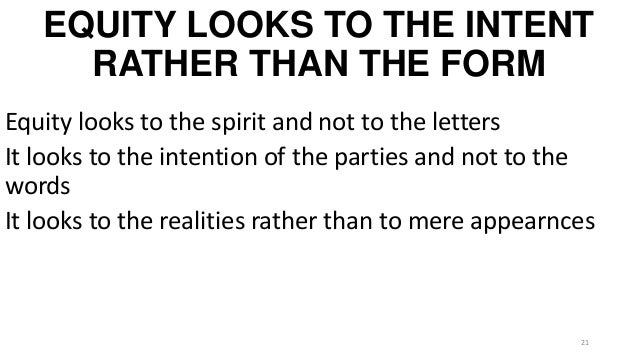
Equity looks to the spirit and not the letters
8. Equity looks to the intent rather than the form.  Equity attaches greater significance to the intent as opposed to the form. It applies in instances where persons have agreed on a certain state of affairs and they have expressed their intention in relation to that state of affairs through a written document, but the document has failed to accurately express their intention. [A mistake has occurred in the making of the document thereby forcing the document not to accurately capture the information it is required to]. In such case, equity will disregard the mistake of the document and instead give effect to the intention of the parties. 
The maxim does not mean that equity attaches no importance at all to the form of documents. It only means that given a conflict between the form and the substance of the document, and the conflict is likely to negate the substance, then equity will overlook the form and uphold the substance. It also means that equity does not like to entangle itself in the technicalities of form but instead prefers substantive justice.
On the basis of this maxim, the courts have accepted that the failure of a party to a contract to perform his obligation within the agreed time does not necessarily defeat the whole contract. If the party is still willing to perform but has only been prevented from doing so by certain circumstances, then the court will still allow him time to perform.
This is thus regarded to be the foundation of Equity of Redemption which allows the mortgagor in default to redeem the mortgage even after the expiry of time.


Equity Looks on that as done which ought to be done
9. Equity looks on that as done, which ought to be done. The maxim means that if there is an obligation that a party is expected to discharge, then equity will consider that obligation as though it has already been performed right from the moment that the party came under obligation to perform it. The maxim applies in instances where parties have entered into a contract by reason of which they have incurred certain obligations which are capable of being specifically performed or capable of attracting the equitable remedy of specific performance.
The rationale behind this maxim is that if a party fails to perform his obligation, then equity will order him to do so by way of and order of specific performance. It is therefore fair to assume in the eyes of equity, that that party is as good as having performed his obligation right from the moment that the contract became binding on him.
This maxim has in practice been applied in the following instances:
i)                    Contract of sale and transfer of property: once the seller executes the transfer he is deemed to have converted himself to a mere trustee to that property until the purchaser takes physical possession.
ii)                  generally in the law of contracts where a party has made a promise to fulfil an obligation, his obligation is deemed as good as fulfilled e.g. in case of Fredrick v Fredrick the defendant had promised to assign certain rights to the plaintiff, the court held that the assignment was as good as done right from the time the contract was concluded.
iii)                In the law relating to trusts, it has been applied in relation to the trustee’s discretionary power of assignment to the effect that once the trustee sets out to exercise that power and he does so in good faith but he does it in a manner that is defective, he will be deemed to have effectively exercised that power.
iv)                In instances where there is an obligation for real property to be converted to personal property and vice versa, the property in question will be dealt with as though it had already been converted right from the moment the obligation arose.
It is the foundation of the rule in Howe v Earl of Dartmouth (1802), the rule is that if residuary personalty (residue of an estate when every other property has been distributed) is given for the benefit of beneficiaries who are to enjoy it in succession, then the trustee is under obligation to convert such part of it as may be of a wasting or reversionary nature or consisting in an unauthorised investment into property of permanent and income bearing nature or into authorised investment.

10. He who seeks Equity must do Equity. This maxim demonstrates that equity may attach conditions to its favours or remedies, it may require the person seeking its favour to also do equity. That is to say that a plaintiff or applicant who seeks an equitable relief against the defendant or respondent may be required to also act equitably towards that defendant or respondent. This maxim focuses onto the future conduct of the plaintiff or applicant and if that future conduct indicates that the plaintiff is willing to treat the defendant equitably then it is said that he is willing to do equity and therefore deserving the favours of equity. If on the other hand, that future conduct indicates that the plaintiff is not willing to act equitably towards the defendant it is said that he is not willing to do equity and therefore not deserving the favours of equity. On the basis of this maxim, the courts have been able to attach conditions to their orders, they have e.g. required the beneficiary of their order to give an undertaking of forbearance, or to even deposit moneys into courts or bank accounts. (Order 26 of Civil Procedure Rules 2010)
In the law relating to charges and mortgages, this maxim has been applied, in the case of Inglis v Commonwealth Trading Firm of Australia, in that case, the court held a mortgagor in default may not be granted the equitable remedies of injunctions against the mortgagee unless he deposits the outstanding instalments and interest into court, similarly in Campbell Discount Ltd v Bridge the court held that even where the hirer is in default he may still obtain an equitable injunction against the owner on condition that he deposits the outstanding instalments into court.

11. Equity Acts in Personum. This means that equity operates through orders and directives which target or are directed at a person in such a way that if a person fails or refuses to comply with the order, then equity will proceed against the person’s person by seizing the person and placing him in confinement/custody until he is willing to comply.
This maxim is today dimmed to be essentially of historical significance. In the earlier days, it was designed to demarcate the boundary between equity and the common law by demonstrating that equity acted in personum as distinguished from the common law which operated in Rem. Orders of the common law were orders in rem while orders in equity were orders in personum.
The idea that equity operates in personum has been used to support the claim that equity has transboundary jurisdiction. This is to say that its orders may affect matters beyond the geographical jurisdiction of the court.
 Before an order is issued in personum, the court has to satisfy itself that the person targeted is within its jurisdiction. It does not matter where the subject matter is located.
Penn v Lord Baltimore- the court of chancery issued an order requiring the performance of certain obligations in respect of boundaries of land located outside the court’s jurisdiction.
Richard West Partners v Dick- the court directed the specific performance of the contract of sale of land outside the court’s jurisdiction.
Webb v Webb- European Court of Justice acknowledged that equity has extraterritorial jurisdiction.

N.B. In modern times it is not necessary to distinguish orders of the court whether they are in rem or in personum.

Labels: ,